Innovation by Design - Engaging Learners and Faculty in Course Design and Development
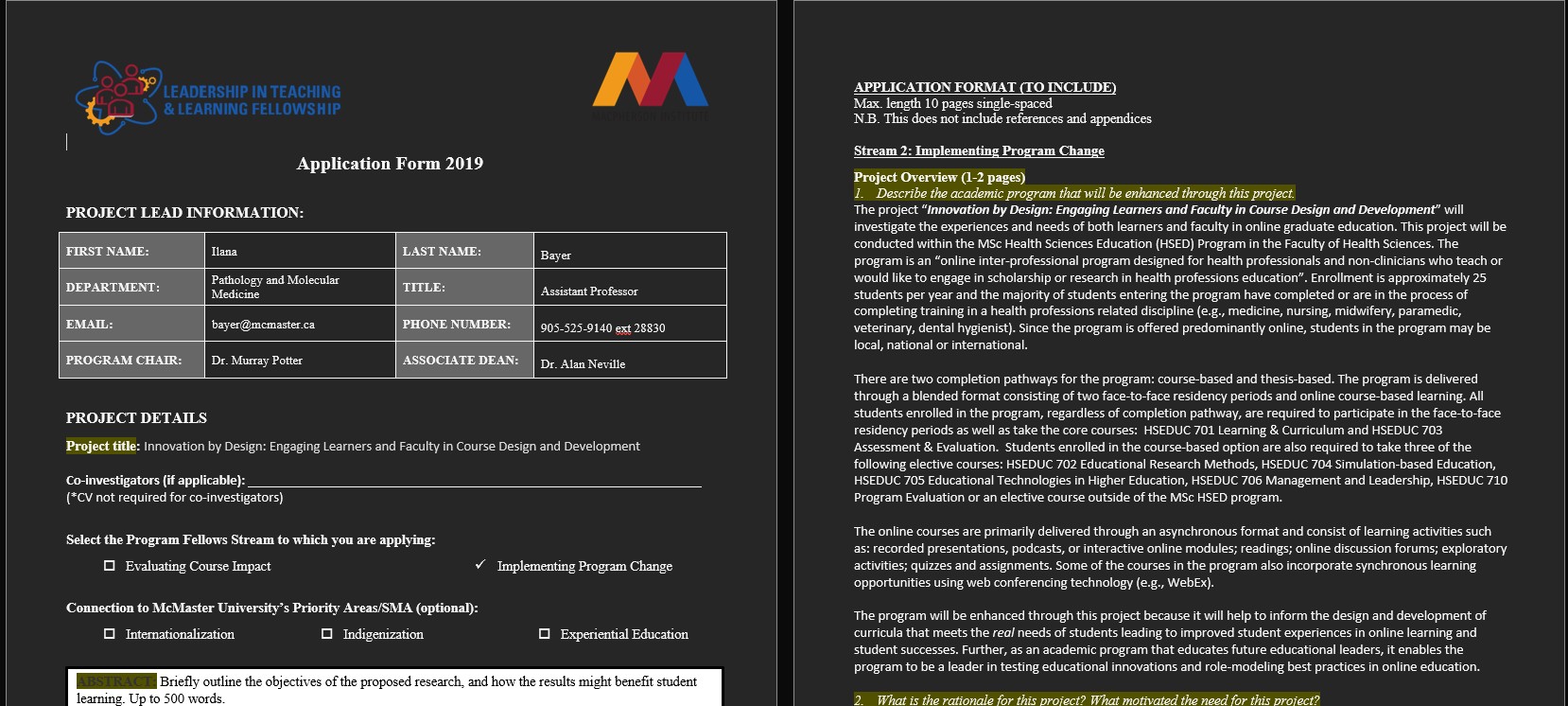
In 2019 I supported Dr. Ilana Bayer in her ‘Innovation by Design: Engaging Learners and Faculty in Course Design and Development’ proposal for the Leadership in Teaching & Learning Fellowship.
Project Overview
“The project “Innovation by Design: Engaging Learners and Faculty in Course Design and Development” will investigate the experiences and needs of both learners and faculty in online graduate education. This project will be conducted within the MSc Health Sciences Education (HSED) Program in the Faculty of Health Sciences. The program is an “online inter-professional program designed for health professionals and non-clinicians who teach or would like to engage in scholarship or research in health professions education”. Enrollment is approximately 25 students per year and the majority of students entering the program have completed or are in the process of completing training in a health professions related discipline (e.g., medicine, nursing, midwifery, paramedic, veterinary, dental hygienist). Since the program is offered predominantly online, students in the program may be local, national or international.
There are two completion pathways for the program: course-based and thesis-based. The program is delivered through a blended format consisting of two face-to-face residency periods and online course-based learning. All students enrolled in the program, regardless of completion pathway, are required to participate in the face-to-face residency periods as well as take the core courses: HSEDUC 701 Learning & Curriculum and HSEDUC 703 Assessment & Evaluation. Students enrolled in the course-based option are also required to take three of the following elective courses: HSEDUC 702 Educational Research Methods, HSEDUC 704 Simulation-based Education, HSEDUC 705 Educational Technologies in Higher Education, HSEDUC 706 Management and Leadership, HSEDUC 710 Program Evaluation or an elective course outside of the MSc HSED program.
The online courses are primarily delivered through an asynchronous format and consist of learning activities such as: recorded presentations, podcasts, or interactive online modules; readings; online discussion forums; exploratory activities; quizzes and assignments. Some of the courses in the program also incorporate synchronous learning opportunities using web conferencing technology (e.g., WebEx).
The program will be enhanced through this project because it will help to inform the design and development of curricula that meets the real needs of students leading to improved student experiences in online learning and student successes. Further, as an academic program that educates future educational leaders, it enables the program to be a leader in testing educational innovations and role-modeling best practices in online education.