An Initiative to Promote Development of Faculty Technology Use in Health Sciences
In 2015 I supported Dr. Ilana Bayer’s “An Initiative to Promote Development of Faculty Technology Use in Health Sciences” research project, which had received a grant from the Forward with Integrity Fund.
I was asked to review and provide feedback on a draft of the paper that was created in August of 2015.
To my knowledge, the paper was never published.
Research Proposal
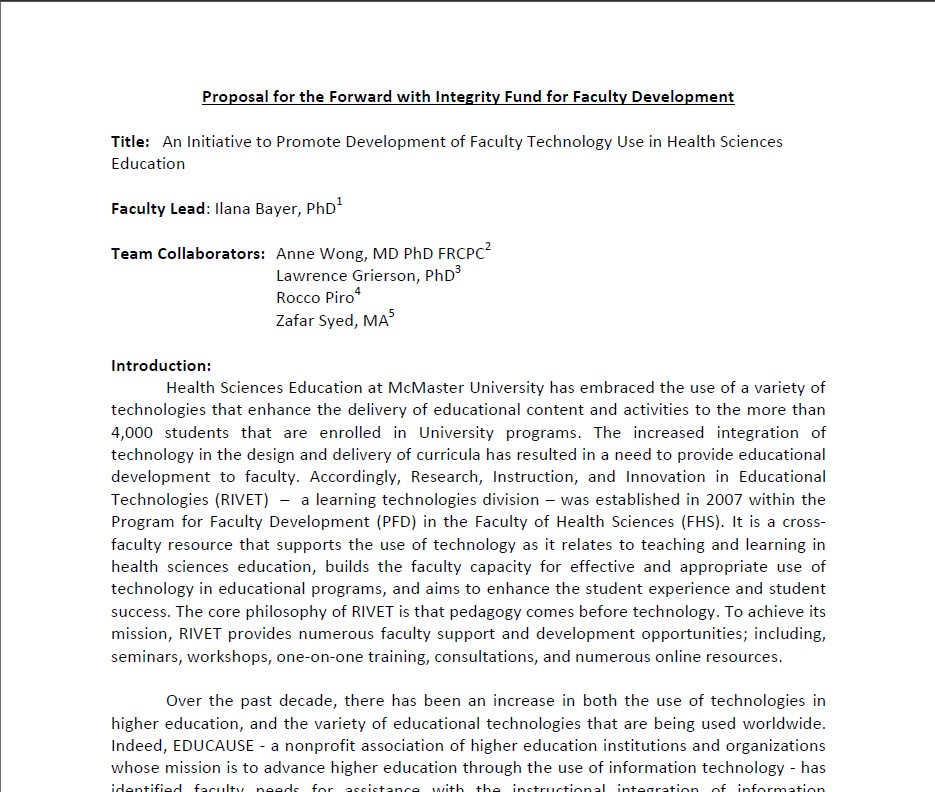
“Health Sciences Education at McMaster University has embraced the use of a variety of technologies that enhance the delivery of educational content and activities to the more than 4,000 students that are enrolled in University programs. The increased integration of technology in the design and delivery of curricula has resulted in a need to provide educational development to faculty. Accordingly, Research, Instruction, and Innovation in Educational Technologies (RIVET) – a learning technologies division – was established in 2007 within the Program for Faculty Development (PFD) in the Faculty of Health Sciences (FHS). It is a crossfaculty resource that supports the use of technology as it relates to teaching and learning in health sciences education, builds the faculty capacity for effective and appropriate use of technology in educational programs, and aims to enhance the student experience and student success. The core philosophy of RIVET is that pedagogy comes before technology. To achieve its mission, RIVET provides numerous faculty support and development opportunities; including, seminars, workshops, one-on-one training, consultations, and numerous online resources.
Over the past decade, there has been an increase in both the use of technologies in higher education, and the variety of educational technologies that are being used worldwide. Indeed, EDUCAUSE - a nonprofit association of higher education institutions and organizations whose mission is to advance higher education through the use of information technology - has identified faculty needs for assistance with the instructional integration of information technology as one of the top-ten information technology issues of 2014, and has accordingly prioritized faculty development in the use of learning technologies moving forward. This has started with investigations into the best practices and models of faculty support across institutions. In FHS at McMaster University, we have a diverse composition of faculty (e.g. full-time and part-time faculty, clinical preceptors, tutors, guest lecturers) who are at different levels of adoption and comfort level with technologies, have different learning technology needs, and that are dispersed geographically. Thus, it is timely for us to research how best to develop and support our faculty in appropriately and seamlessly integrating educational technologies.
This initiative will be led by Dr. Ilana Bayer, an Assistant Professor in Learning Technologies and the Director of RIVET. Dr. Bayer oversees RIVET’s activities including the creation and delivery of the educational development opportunities for faculty. Her research interests include individual technologies and technology use in health science education, as well as technology implications for faculty development. Further, this initiative is an opportunity to formalize research collaborations between units within FHS and the McMaster Community that have shared interests and mandates. Each collaborator listed in this proposal brings a certain expertise and unique perspective on aspects of faculty development; including, its relevance to higher education (Dr. Anne Wong, Assistant Dean for the Program for Faculty Development), educational scholarship (Dr. Lawrence Grierson, Education Scientist in the Program for Educational Research and Development), technology services (Rocco Piro, Director, Information Technology, FHS), and the use of technology in teaching and learning throughout the greater McMaster community (Zafar Syed, Associate Director of Educational Technologies for the McMaster Institute for Innovation and Excellence in Teaching and Learning). The relationships formed as a result of this collaboration will establish a foundation for future collaborations on scholarship of educational technology as it pertains to faculty development and teaching and learning.”